Observations on Common Core and More – Market Solutions Please

145_0219

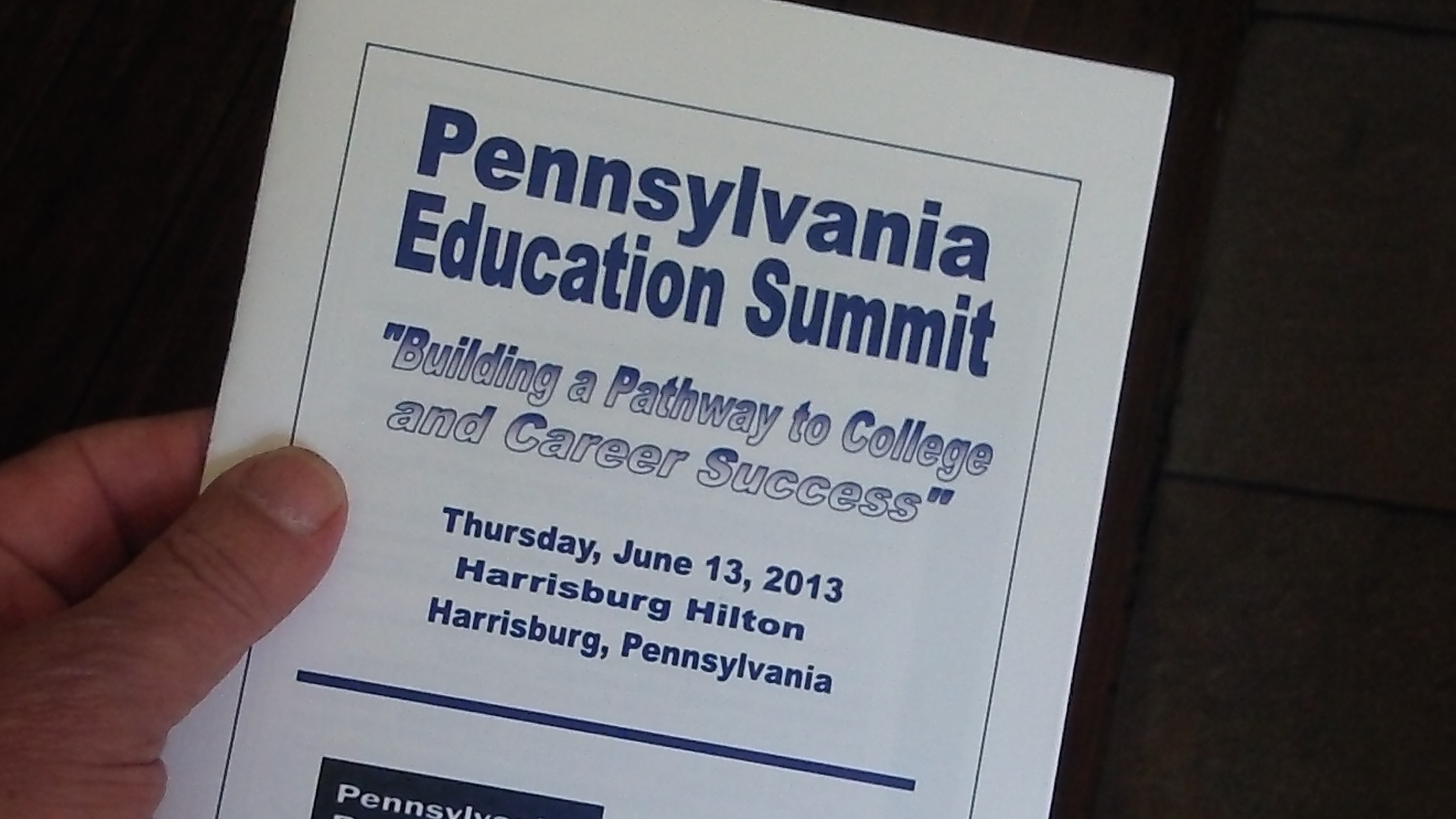
On June 13 of this year the Pennsylvania Business Council along with Pennsylvania Partnerships for Children and Team Pennsylvania Foundation hosted the Pennsylvania Education Summit, using the tag line “Building a Pathway to College and Career Success”.  For anyone interested, I created a scrolling video record of all tweets using the suggested hashtag #PaEdSummit, as a collection of observations of the many in attendance.  I thought maybe a summit would be just that, an event defining problems and seeking answers, from many ideas and points of view.  Indeed it did define problems, but then focused nearly entirely on one answer, the Common Core Academic Standards.  I was attending a Common Core love fest.

While I’ve learned more about Common Core and its origination and distribution since the summit, I knew enough at the time to know what I saw as dangerous and offensive to freedom, and had doubts that Common Core is even working on the right problems that are causing agreed failures in our schools.

First, dangerous and offensive: Putting together Common Core involved large sums of private money, reportedly $150 million alone from Education Summit sponsor Bill & Melinda Gates Foundation, and was written by a handful of elite authors.  The Federal Department of Education presented states “offers they could not refuse” in Race to the Top money and No Child Left Behind waivers to get almost all (45) states to agree to the new standards in short order, as few people noticed.  If only we trust in the wisdom of these changes and align as one, this new effort at central planning will solve our problems as previous efforts, going back to Outcomes Based Education have not.  Just have faith.

But isn’t this the adoption of a monopoly of ideas so heavily invested failure will not be tolerated, continuing and intensifying pressures that have resulted in test answer changing scandals that even had Michelle Rhee refusing to answer questions?  Is it not also a dangerous path where large moneyed private interests can, in effect, set public policy without the consent of the elected representatives of the people?  Isn’t education better left without the involvement of the federal government, where states can be the laboratories of innovation?  Hasn’t education , if anything declined in quality since a stand alone federal Departmant of Education?  And since when do Americans align?  Americans innovate and break molds and build new ones in searching out opportunity and success.  The summit wasn’t about consideration of any of these issues or ideas.

From time to time I injected my counter views and concerns into my tweets, but they were never acknowledged in the presentation.  Finally in the last panel, state Senator Mike Folmer raised the issue of support in the home, that no new plans at the top are as important or necessary as supportive homes.  It was the stimulus I needed and I went to the microphone for Q&A with an infusion and intrusion of counterpoints and opposition.

I acknowledged the description of problems and good intentions then challenged the panel to tell me why Common Core is the magic elixir that will bring success as previous attempts have failed.  I made the suggestion that other factors may be at work,  as time has changed many things in our society, such as the advent of poor public policy in the area of social welfare that has provided perverse incentives toward single parent households, as well as the necessity for many two worker households, where neither parent has enough rested time with their children.  Seeming to support this possibility was an admission from the President of Elizabethtown College that our failures are concentrated in our 30% worst performing schools, without which we would compare favorably with the best in the world.  For that we seek to impose expensive cumbersome changes on everyone instead of focusing on the 30%?

I acknowledged the comment of Senator Folmer and as a specific example, spoke of a young Dr Benjamin Carson and how only a caring uneducated and probably illiterate mother who demanded reading books over watching TV was the determining factor in removing him from a path to failure; how then when he felt empowered by and accepting of reading, it was in that moment that a future successful pediatric neurosurgeon was born.  These were questions and considerations not included in the agenda of this summit.

As the panel was, what I felt, mostly dancing around my concerns in their response, I readied for my finale, three words in closing: choice, vouchers, and competition as the proven market approach that would likely do the most to improve all our schools, building a floor for quality and value in its process.  As the moderator went into wrap up mode I knew I wasn’t going to get the chance.  I decided to leave before the 15 min ending “Where do we go from here?” message.

On my way out I was stopped by Mr David Patti, President and CEO of the Pennsylvania Business Council.  He most graciously thanked me for attending and suggested this is one issue on which we don’t agree even as he appreciated my remarks.  I told him about the three words I had wanted to say.  When Mr Patti looked at me and said that the Business Council favors that also I was befuddled and remain so to this day.  Central planning and market solutions are at opposite ends of the Conflict of Visions described by Dr Thomas Sowell in his 1987 classic work.  Attempting to entertain both, in my opinion, is an internal conflict for those who try, and I am left puzzled when business people do not look first and foremost to the marketplace as the source of innovation and solutions that has consistently made America the envy of the world.

The experience reminded me of a similar situation, in which the Pennsylvania Chamber of Business and Industry took a position favoring Pennsylvania’s setting up a state run Obamacare exchange.  Despite phone conversations, emails and references to articles by Cato and others, I was never able to convince Chamber Chairman and CEO Gene Barr to end that support and back concepts to incentivize state employers to embrace high deductible health plans and health savings accounts, with their connection to market forces.  In talking to Mr Barr at the Education Summit he still defended state exchange support.

More than Common Core and more than healthcare I sense a disturbing trend inside the business community to not embrace and show unwavering faith in free markets over government schemes, especially central government impositions.  Yet then there are others like NFIB or the Pennsylvania Manufacturers Association who are  more consistently standing up for freedom.  In these times everyone must be standing on the side of freedom.

In one final note StudentsFirst.org was also a sponsor of the Education Summit.  This is Michelle Rhee’s creation and sits firmly in the unconstrained (Sowell) vision, accepting of elitists among us capable of divining solutions for the rest.  In keeping Common Core under the radar as long as it was, it seems curious, significant and deliberate that Rhee’s February 2013 book “Radical…” does not mention Common Core even once.

Note: This post was shared to WatchdogWire-Pennsylvania
Scandal in Harrisburg PA at 2nd and State?

100_0454

I don’t live in Harrisburg but visit our state Capitol often in my role as a citizen lobbyist.  I do this at my own expense, a significant part being parking.  On-street is much cheaper than the garage but still $1.50/hr in the immediate area can add up and there’s always the risk of a ticket.  It is from this perspective that the appearance of one parking spot just a block west of the Capitol caught my attention.

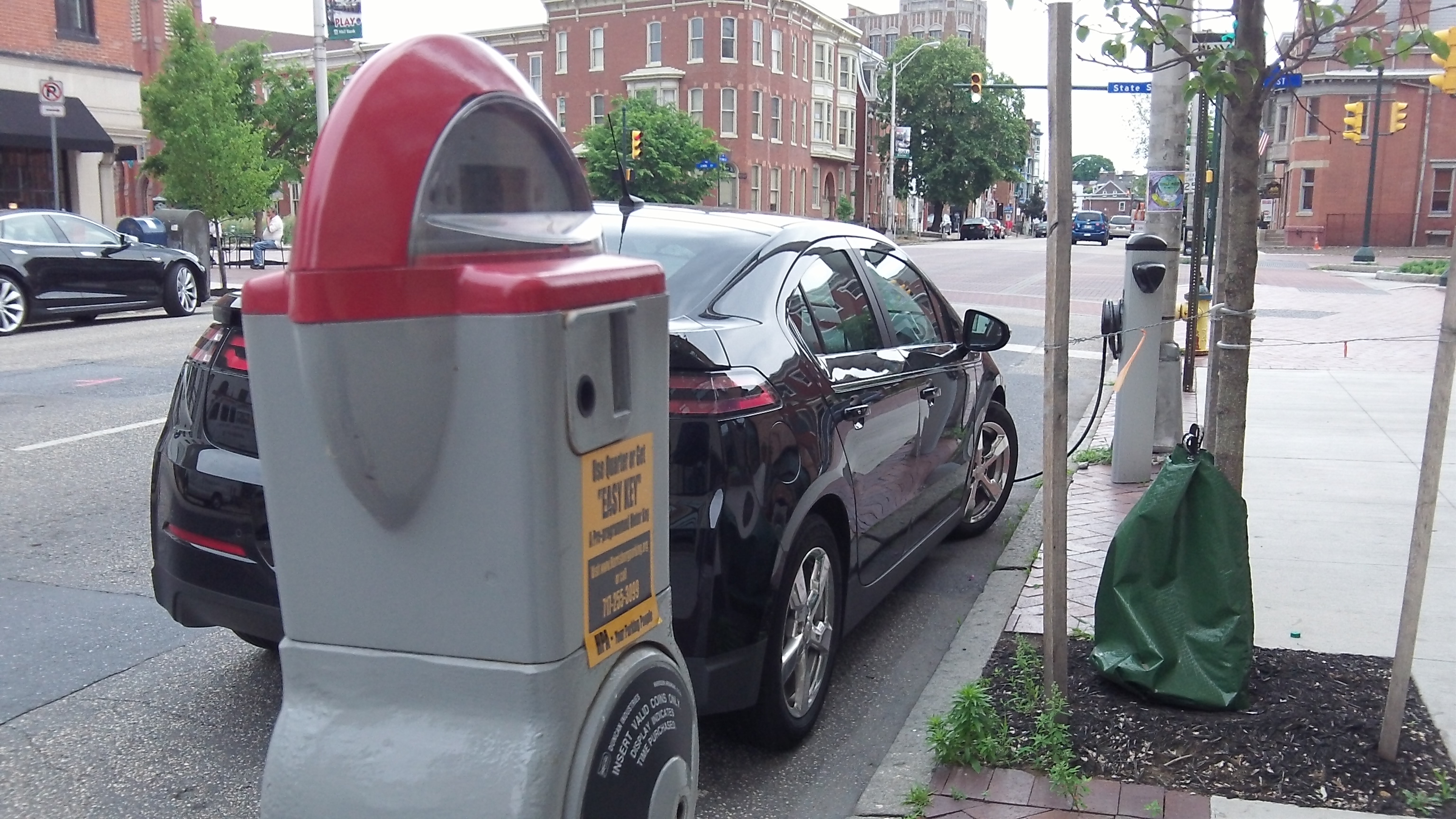
I noticed the first parking spot on 2nd St off the southeast intersection with State St had an electric vehicle (EV) charger but no parking meter.  Neither were there any signs indicating terms of use.  Also missing was the typical “No Parking Here to Corner” sign.  Information on the charger’s screen indicated a charge of $.15/kwh for electricity consumed.  For a few months prior to the end of June as I visited the Capitol more often due to the increase in legislative activity, the same black Chevy Volt was in the charging spot from about 7am until around 2:30-3:00 pm, what seemed like every day.  Knowing the owner of that Volt was eligible for a $7500 federal tax credit plus a much lesser known $3000 rebate from the Pa DEP, neither of which I support, I bristled at the thought of further perks like a whole day’s free parking!  I had to know more.

Curiosity began with a Google search that quickly found answers that posed more questions.  A story in the Central Pa Business Journal November 21, 2012 indicated the charger was sponsored by Sutliff Chevrolet with the involvement of WCI Partners and its managing partner Alex Hartzler, a Harrisburg real estate developer.  Hartzler’s firm developed the five story building outside which the EV charger was installed.  Also Hartzler has a connection to electric vehicles as the owner of an ultra high end Tesla.  The report said the charger cost $15000 to buy and install, was available to the public with no charge for parking but a two hour limit applied.  The black Volt was plugged in over 7 hrs most days.  What was meant by “sponsored”?  Was the city or Parking Authority being reimbursed for revenue forgone by having no meter? Was the city paid a fee for the right to claim sponsorship?  Why was there never a parking ticket on the black Volt for exceeding the 2hr limit?  What if I parked my non electric car there?  Who receives the payments for electricity used?  Were any public funds part of the $15000 installation cost?  Who owns and maintains the car charger?  I wanted to know a lot more.

I called WCI Partners, explained my concerns, left contact information, was told Mr Hartzler would get back to me but he did not return the call.  I visited Mr Richard Kotz, head of the Harrisburg Parking Authority.  He said he would look into the situation, being aware of no agreements with the Parking Authority concerning the spot in question.  I talked with Parking Enforcement.  They said they wondered about that spot since the charger was installed but were never told anything about it and could not enforce any rules without signs being posted.  No one seemed to know anything so I decided to ramp things up.

Before Mr Kotz at Parking Authority could get back to me I presented a Right to Know request asking for three simple things: 1) Copy of any agreements related to the situation 2) Terms of use 3) Records of charger usage and the payee.  Mr Kotz dutifully responded to my request that “none of the information requested exists at HPA”, after which he suggested trying the City of Harrisburg.

Prior to presenting a Right to Know request to the city I sent Mr Hartzler an email since his address was right there on the WCI Partners website.  I presented my questions and asked that he either respond by email or call me.  Later the same day he called.  In that conversation he confirmed that he put the charger there as something nice to do for the community.  He claimed that all payments pass through, that he makes nothing, which at $.15 per kwh is easy to accept.  He also said that the city is not losing any parking revenue since there never was a 100_0496parking meter or parking spot at that location prior to the charger’s installation.   He also informed me that signs were now placed saying “Electric Vehicle Only” and “2 Hour Limit” along with one that says “Sponsored by Sutliff Chevrolet”.  Keep in mind this is all happening in the public right of way, normally used for on-street parking under the direction of a city or its Parking Authority.  Surely arrangements must have been made with the city, if not its Parking Authority.

The next day, Tuesday July 9, I personally delivered a Right to Know request to the City of Harrisburg.  I asked what I had asked of the Parking Authority with a few additions.  This was my request:

1)      Any and all records of correspondence, meeting minutes, or any public records produced in connection with the approval of installation of Electric Vehicle (EV) charger and designation of parking space as free of charge on State St at 2nd Street, within the public right of way, normally considered on-street parking, especially agreements between the City of Harrisburg and developer J Alex Hartzler, WCI Partners, Greg Sutliff, or Sutliff Chevrolet, arrived at either in public forum by elected officials or privately by city agencies or employees.

2)      Agreement as to reimbursement to the city for forgone parking revenue in absence of parking meter.

3)      Terms of public use of above mentioned parking space and electric charger.

4)      Usage records of EV charger since Fall 2012 installation and identification of payee for electricity consumed.

5)     Owner of Electric Charger and who is responsible for upkeep and servicing.

As with the Parking Authority, the City of Harrisburg dutifully responded.  Also, as with the Authority no records could be produced related to the charger or the now suddenly signed parking space.  How is it possible that one citizen or a small group acting alone could be making public policy, installing EV chargers or hanging signs in a public right of way without permission?  Also in my phone conversation with Mr Hartzler he suggested that because I don’t live in Harrisburg, I have no standing in this issue.  But what if Hartzler, WCI Partners or Sutliff shared in grants from the state DEP that are available for electric vehicle charger installations  as did Amerigreen Energy of Lancaster, as outlined in another CPBJ article?  Then every citizen of the state would have standing, beyond the absolute right of anyone to merely be curious or ask questions.  Taking public money should, after all, also involve taking what comes with it.

A couple more mysteries remain.  Who put up the new signs in the absence of any agreements: the City, its Parking Authority, or a private citizen, and are they enforceable without official terms of use ever having been adopted?  Also what about the normal “no parking here to corner” signs that dominate the last parking spot before an intersection to protect public safety?  Did one ever exist at this location as they seem to throughout the city, including on the other side of 2nd St at State?  Could it have been removed and never replaced in the process of construction of the new building?  I’ve informed City of Harrisburg officials of the absence of such a sign.  As a non resident, having expressed my irritations, I’ll now leave these unresolved issues with the citizens of Harrisburg and their chosen officials or perhaps other curious visitors.

Note: This post shared to WatchdogWire-Pennsylvania

State Pension Reform Should Look to the Federal Thrift Savings Plan Model

tsp2

Many states are currently facing unfunded liabilities to their defined benefit pension programs.  Pennsylvania, in particular is over $40 billion short of its obligations, alone about 1.5 times its entire yearly budget.  Borrowing a concept from the private sector, and favored by Governor Corbett, is a plan to move all new state employees into a defined contribution 401k type program.  While the move to defined contribution makes very good sense, it is important to recognize the problems with this approach and avoid them, doing the best we can for our state employees.

Defined contribution is subject to failure on two fronts.  First are high costs that limit investment returns.  Many plans offer overly expensive investment choices that, because of the high costs, often in the short term and pervasively in the long term, do not match the returns of simple passively managed low cost index funds.  Then to make matters worse, responsibility to select the right mix of investment choices is dumped into the laps of ordinary workers (and some very smart workers also) who know little to nothing about the principles of sound investing, thus becoming their own worst enemy by allowing their emotions to make decisions that put them on a path to very poor results.  The good news is that it doesn’t have to be this way and there is a superior model that all can strive to achieve.

The most surprising thing about this defined-contribution-done-right example is the source, that being the Federal Government, of all places!  It’s indeed uncanny and hard to admit the Federal Government doing anything better than the private sector but the Thrift Savings Plan does just that.  The TSP is administered by the Federal Retirement Thrift Investment Board, an independent agency of the Federal Government established in 1986.  It now has over 4.5 million participants with $374billion in assets at the end of 2012.

What sets the TSP apart from most plans offered in the private sector is its strict adherence to low cost and simplicity.  It currently offers only five investment choices plus target date collections of the five funds designed to produce the highest returns for the least amount of risk appropriate.  The target date funds were added in August 2005 to address unprepared employees choosing poor fund mixes and then trading them on emotion to their detriment.  The target date mixes are determined by scientific methods looking at past volatility and returns of the individual asset classes as well as how they tend to move relative to each other, combined with the participant’s individual time horizon.

While private sector 401k plans are dominated by actively managed funds that purport to be run by managers clever enough to beat the market, all TSP funds are passively managed index funds that won’t beat the market but guarantee capturing the generous returns the markets make available over time less very small expenses to do so.  The dirty little secret is that attempts to beat the market most often end up trailing the market, mainly due to the expenses incurred in the pursuit.  Study after study confirms this as presented in the writings of such investment heavyweights as John Bogle, founder of Pennsylvania based Vanguard Funds, who in a 2006 interview for Frontline noted:

“So our legislators and our federal employees get these great benefits through as close to a perfect retirement plan as you can have ……  We don’t do that for our regular citizenry.”

Attempts to require private sector 401k plans to offer even one low cost index fund has been a struggle.  The TSP, using only index funds, offers coverage of five distinct asset classes for an expense drain to the worker that is the lowest anywhereExpenses compound in the negative as returns compound in the positive and can alone result in huge differences in account balances at retirement time.  The actual numbers will seem untrue but they’re not.  While many private 401k plans impose reported expenses to the investor in excess of 1%, or 100 basis points, the TSP reported 2012 expenses across all funds of an amazing 0.027% or 2.7 basis points!  The actively traded fund manager hoping to beat the market must make up this difference just to break even because the expense of trying is passed through.  In addition to reported expenses are those that are hidden but real nonetheless.  A good article at Nerd Wallet lists 28 known potential hidden fees and shows by example how differences in expenses will drastically affect outcomes at retirement.

So when states look at defined contribution there are important choices within that choice that deserve attention.  One approach that should certainly be considered and has yet to be attempted to my knowledge would be for a state to petition the Federal Government for voluntary participation and inclusion of its  employees within the Thrift Savings Plan.  So long as the TSP could accommodate unique matching and vesting criteria for each state’s employees, this expansion of the TSP into state governments should only benefit both states and their workers.  In addition, a smoothly running structure that has been developed over time would save the expense to reinvent it.

In March I proposed this concept to one of the best investment advisors I know on his Saturday radio show, Financial Freedom, on WHP 580 in Harrisburg.  Mr Tim Decker, host of the show, was fully supportive of the idea and the various legislative committees now considering pension reform would do well to seek input from Mr Decker.  Our radio conversation can be heard here.  Jump to 14:00.

Just yesterday morning on CNBC’s Squawk Box, Larry Fink, CEO of BlackRock, the largest investment management firm in the world, appeared with Congressman Paul Ryan.  Both were singing the praises of the Federal Thrift Savings Plan, presenting it as the best model for individual retirement accounts.  Significantly this is exactly what George W Bush suggested as the basis for voluntary private Social Security accounts.  Will Pennsylvania and other states make the TSP their model for state employee pension reform?

Note: This story was shared to WatchdogWire-Pennsylvania

How the US Postal Service Could Possibly Save Itself

Just last week the United States Postal Service announced another $1.9 billion loss in just one quarter, with the warning that without substantial changes the losses would continue to mount.  Something has to give.

Retired from the Postal Service, I have some ideas on what needs to be done to save this Constitutionally provided institution, and a new line of clothing, mentioned several months ago, does not even make my list, nor do I think elimination of Saturday delivery alone would be sufficient.   During my career I carried mail, worked inside a large postal plant, and collected data for a year.

It was that year of collecting data that foretold today’s inevitable crisis.  The year was 2000, and at that time as I remember, first class mail was less than half the letter mail volume but more than half total postal revenue.  The problem was that, of that first class mail, somewhere around 70% consisted of bill presentment and payment.  The writing was on the wall.  Much less bill presentment, bill payment volume has evaporated to the internet and will continue even more.  This was one major straw that broke the back of a camel already straining under what the postal service failed to recognize early on, that the business was becoming about the delivery of things rather than information.  Other substantial problems contributed to the current situation, but the loss of quality volume sufficient to sustain delivery to every delivery point six days a week was an inevitable result of new information technology and beyond the post office’s control.  Simply cutting the workforce and utilizing a heavy application of sorting automation, in many ways commendable, could not keep up with the deteriorating situation.

Political considerations put cutting several known sources of waste beyond reach that could have delayed, but only delayed, the current crisis.  One example, but certainly not isolated, happened near where I live.  Two small towns that appear as one are separated only by a railroad track.  Each had its own post office with its own postmaster and staff, and unfortunately still does.  One town outgrew its office.  Since the two towns together are smaller than many single towns, the opportunity was perfect to build one new office large enough to accommodate both.  I’m not sure if this was even suggested, but am confident, if tried, the local congressman would have been besieged with calls from one of these adjacent towns about losing its identity or the hardship of having to travel perhaps a half mile further to reach the new combined office.

Another common well-known waste that politics preserves occurs in suburban neighborhoods that originally had mail delivered to a box attached to the house or through a slot in the front door, rather than a box at the curb.  In such situations the carrier drives to the area, parks and walks to each house, then moves the vehicle to the next area, over and over.  Yet by all appearance such neighborhoods are identical to others where curbside boxes were required from the start, and delivery from the vehicle is several times more efficient.  Private businesses looking at the current postal challenges would quickly change this, but under the political connection no one dares to even try.

Unions are another obstacle to efficient operation in ways other than wages that exceed the skill level.  Removal for poor performance or abuse of leave is extremely  difficult.  The workplace is fractured into crafts, each represented by its own union, so employees of one craft may not touch the equally low skilled work of another.  At one time this could work, simply not today.  One would think when workers at some plants, willing to work many hours of available overtime, can earn in excess of six figures, there would be concessions to overall efficiency and responsibility to secure the remaining jobs of all.

That brings us to today with the postal service looking to cut Saturday delivery to keep itself afloat.  This is attempting to put a band-aid on a gaping wound, and will be difficult to manage as well, as every Monday will follow two non delivery days and will be like the current volume anomaly of Tuesdays after Monday holidays.  Of course there will still be Monday holidays and those Tuesdays will now be after three consecutive non delivery days, what I can only imagine as a volume-overload management nightmare.

With that we get to the only possible solution I can conceive, the immediate move to three-day M-W-F delivery.  While each delivery day volume would increase, it would be more manageable by being more consistent day-to-day.  Such a move would mean adding carriers as some routes would have to be cut slightly (but not nearly by half) to get the job done.  Savings would be attained by cutting the use of delivery vehicles substantially.  The other significant savings would require a major change of workplace rules where carriers not delivering express mail and priority parcels on Tu-Th-Sa would be working in plant preparing mail for delivery, replacing work being done by clerks and mail handlers now, eliminating many of those positions.  Consideration would have to be made to occasionally deliver on Tu-Th-Sa in working around holidays.

Proposed plans are to continue delivering parcels six days a week and I would assume express mail also.  Most offices could do this job with one of every three or four current carriers, leaving the others to work in plant.  Limiting six-day parcel delivery to priority rate parcels would encourage greater use of the higher priority rate.  For letters considered urgent there already is a flat rate express letter option that does not require a time-consuming signature.  Out of the box thinking and a willingness to be flexible with current workplace rules and a decidedly more radical approach is necessary to potentially continue the US Postal Service as a self-sustaining entity in the twenty-first century.

Note: This post shared to WatchdogWire-Pennsylvania

Unsavory Observation in PA Budget Hearings – Let’s Fix This….and More

I must be one of those Wacko Birds.  Sometimes in the middle of the day I watch Pennsylvania’s version of C-SPAN, PCN-TV, carrying the riveting excitement of live committee hearings in our state legislature, but then I watched bowling on B&W TV as a kid.  While watching recent House Appropriations Committee budget hearings I made a rather unsavory observation.  Names have no purpose or importance here, because unsavory emanated from both parties and seemed to be part of the process, just business as usual.

What bothered me were pleas to the committee to reinstate appropriations to non-profit organizations in the private sector and/or increase their funding more than it had been.  This is my money.  While I don’t entirely think it is wrong for government to assist non-profits, especially if it can be demonstrated that the actions of the non-profit save the taxpayer money or have a valued function that is better administered in the private sector, direct assistance through taxation takes not only my money but my choice.  Picking and choosing with other people’s money creates wars for contributions that should exist but not inside the halls of government.

It would be much better and much cleaner if all government assistance to non- profits was based on the School Choice EITC model, an indirect approach to assistance.   This model returns voluntary choice to individuals or corporations or tax paying groups as it should be, by allocating pools of potential assistance that would only be paid as tax credits in return for voluntary contributions competed for in the private sector.  Cleaner still would be if tax credits were less than full reimbursement, say 75% to 85% of the donation amount, leaving a portion squarely on the shoulders of the contributor, as any reimbursement still is other people’s money and this would prove true intent rather than a scheme to merely pass through public funds.  Any non-reimbursed amounts would still be eligible as a deduction on federal returns.

Large highly valued needs, such as education scholarships to attend charter or private schools could stand alone with their own appropriated fund.  Smaller more numerous non-profits could compete from a common pool appropriated for the potential benefit of any.  Strict value and need standards would have to be met to be allowed into the pool of potentials.  Proof of economic benefit to the taxpayer or extreme social need should top the list.  Perhaps legislators should vote individually for non-profit inclusion on common lists among those that pass independent screening.

Of course any such funds, single purpose or multi-purpose, must have caps to protect the taxpayer and otherwise budgeted revenue.  From there it would be first come first served to obtain the available credits.  This restores valuable elements of true charity while eliminating the unsavory sight of legislators publicly begging on behalf of any specific non-profit organization for the money of others perhaps against their will.  It also effectively isolates and quarantines useful efforts, voluntarily embarked upon by people of vision, from the entanglement of government, with its regulations and rules and departments and bureaus and employees and unions and pensions and all ancillary issues it invariably brings with it.

EITC for education has been a great success for helping deserving students avoid failing schools.  Sometimes incentives for desired voluntary efforts could take forms other than tax credits.  Such would be the case with an act like NJ Senate No 2231, that would replace government entanglement in Medicaid by granting immunity from civil malpractice liability in all their practice to physicians and dentists who agree to donate at least 4 hours per week in a non-government free clinic, a wonderful concept that could so attract participation that there would be a shortage of available free clinics.  Since this approach has been predicted to hold potential for both huge savings to the taxpayer and better access to higher quality health care for the poor, the EITC model could then be employed, with a dedicated fund of tax credits limited in size only by attracting enough voluntary contributions for a sufficient number of free clinics, themselves independent of any government ties.  Because of substantial predicted net savings to the state by bypassing Medicaid, extending whatever voluntary credits as necessary to assure every willing physician the needed resources would be entirely warranted.

It’s not hard to see how, in many respects, this approach to getting desired things done is revolutionary and refreshing.  I can’t imagine it would be that hard to address my unsavory observation and not only fix it but head down a new path that would better respect freedom while benefiting us all.

The Insidious Non-Optional Medicaid Expansion That Further Clouds the Future for States

So much about Obamacare has been “by any means necessary”, from the legislative gymnastics to get the bill through Congress to the current mandatory expansion of Medicaid that is here now even though largely unnoticed.  Here now?  But wasn’t Medicaid expansion optional?  Some yes and some no as it turns out.  This almost unknown stealth expansion was required of the states and imposed on them despite the Supreme Court ruling because it is being funded 100% by the Federal Government, but only for two years 2013 and 2014, after which, funding abruptly ends.  Because a strong constituency is being created (or bought) that will demand this expansion be continued past 2014, and no one can predict the outcome of those likely demands, further possible complications and risks arise for those states that decide to embrace the optional Medicaid expansion.  Allow me to explain.

Because of current constraints to participation by medical professionals both by low reimbursement rates, 1800+ pages of cumbersome rules, and audits that go beyond financial fraud to interfere in actual treatment decisions, there are at present not enough willing doctors to adequately serve those now eligible for Medicaid benefits.  Realizing this, and attempting to avoid making the optional expansion to 133% of poverty and influx of new eligibles a disaster, “any means necessary” was once again deployed.

On November 6, 2012 (surprisingly not a Friday) CMS published a Final Rule to go forward.  146 primary care Medicaid services identified by the ACA would, by regulatory proclamation, be compensated at the higher Medicare rate, starting with 2013 but only for two years.  Since Medicaid reimbursement rates relative to Medicare reimbursements vary tremendously from state to state, the percentage increase covered by Federal funding varies accordingly.  At one extreme are two states that surprisingly pay higher Medicaid fees for the covered services than they do for Medicare.  These states will receive no additional Federal funding.  At the other extreme is Rhode Island, where Medicaid fees will increase 198%.  Five other states will receive boosts of over 100%.  Pennsylvania is number seven on the list and doctors will be compensated an additional 96% to equal the higher Medicare rates.  On average across the nation Medicaid fees for the ACA primary care services will rise 73% at an estimated cost of $11.9 billion, all in an attempt to keep willing physicians on board, expand their willingness, and attract newcomers.

The problem, of course is what happens after 2014.  It is unimaginable that doctors enjoying the higher reimbursements for two years will do anything but lobby stridently to extend the increases and indeed have them made permanent.  Realizing, otherwise, the carrot to participation would no longer exist, this outcome can be considered probable.  The mystery is who would then pay?  Would the increase be included in the ultimate 10% state funding under optional expansion to 133% of poverty or even some formula that would require states to pay more? Would the increases fall to each individual state or be averaged over all the states?  The point is that today no one knows.  While perhaps not being the main reason to avoid the optional Medicaid expansion, especially those states with the greatest percentage “temporary” increases need to consider the possibility of very serious consequences in the aftermath of this two year attempt by the Federal government to buy a loyal constituency for implementation and avoidance of massive failure.  It is also interesting that the current reimbursement increases were only applied for two years, as estimates for the cost of Obamacare have been made over a ten year period, allowing more, for now, to remain hidden from view.

The two main sources used for this post were a policy brief from the Henry J. Kaiser Family Foundation and an article in American Medical News published by the American Medical Association.  More details can be found at these two locations.  Also used was a recent article written by the President of the Texas Medical Association.

Note: This post was shared to WatchdogWire-Pennsylvania on Sep 24, 2013.